EMAIL US:salesmanager@singi.com
- All
- Product Name
- Product Keyword
- Product Model
- Product Summary
- Product Description
- Multi Field Search


Views: 106 Author: Mark Zhang Publish Time: 2026-09-07 Origin: 本站
SolGrid O&M Services, a maintenance contractor for photovoltaic plants in southern Spain, operates and maintains 200 MW of distributed solar generation. Every month, technicians inspect 1,200 low-volt-level distribution boxes that connect string circuits to inverters. Each inspection demanded full access to the internal busbars and breakers, which meant opening heavy opaque steel covers and isolating the circuit. In May 2023, SolGrid replaced these covers with the GNB60 Flush Mounted Transparent Cover from SINGI. The change cut inspection time by half, eliminated most isolation-related production losses, and improved worker safety.
SolGrid is not a utility but a specialist operations and maintenance firm. Its clients are asset owners who want maximum-val yield from their PV plants. SolGrid employs 34 field technicians and handles two main tasks: reactive fault resolution and scheduled preventive maintenance. The distribution boxes in question are wall-mounted enclosures, each housing a main switch, fuses, and monitoring terminals. They are located outdoors near the PV arrays, so they must seal against dust, rain, and extreme heat.
Before the change, the boxes had standard steel doors with gaskets. The doors were opaque and held closed by quarter-turn latches. To inspect the breakers or read the volt-level meter, a technician had to unlock the door with a key, support the door while checking the live components, and then close and lock it again. That process looks easy on paper, but under site conditions it created a bottleneck.
The first problem was time. Solar arrays are spread over hectares, and a technician can spend up to 12 minutes at each box: opening, visually inspecting, testing with a multimeter, then closing. With 1,200 boxes inspected monthly, inspections consumed 240 person-hours per cycle. The second problem was risk. Opening an opaque cover exposes the technician to live busbars if the switch has not been isolated. Several near-miss incidents were reported in the year before the retrofit. Third, opening the cover triggered the inverter’s ground-fault supervision because the box’s door interlock was not always reliable. That caused false alarms and unnecessary shutdowns.
SolGrid had tried a few fixes. Its technicians applied transparent acrylic sheets over the openings, but the sheets were not UV-stabilized and yellowed after six months. Another attempt used large plastic windows riveted to the steel doors, but the gaskets leaked, allowing water to reach terminals. Neither solution solved the fundamental conflict between visual access and protection.
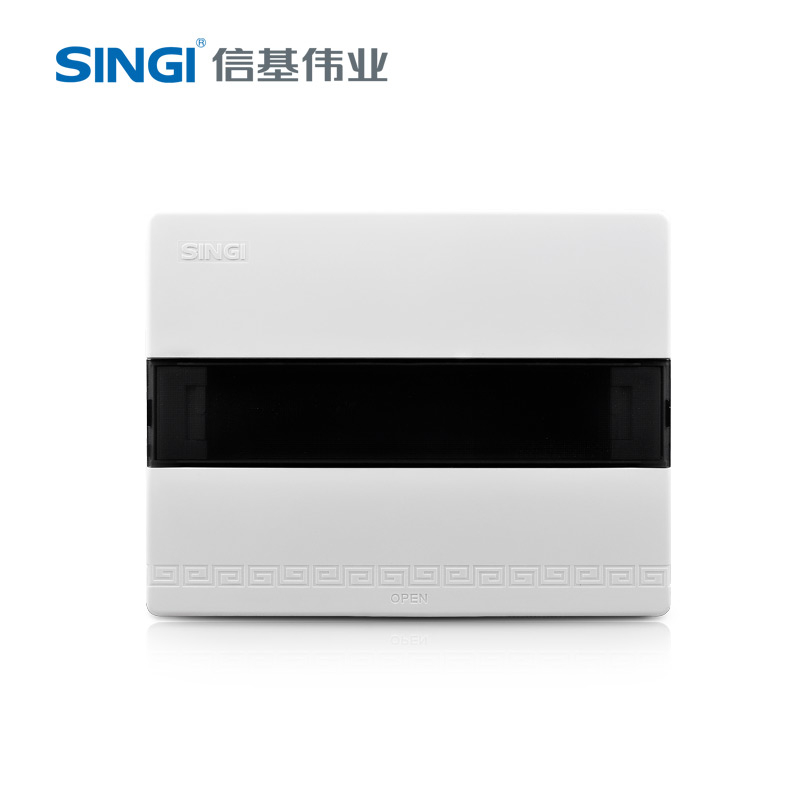
The decision came after a comparison of three options: (a) custom-manufactured acrylic windows, (b) hinged metal covers with small viewing slots, and (c) the SINGI GNB60 flush mounted transparent cover. The first option was cheap but unproven in outdoor UV environments. The second still did not allow a full view of internal components without leaning in. The GNB60 offered a clear polycarbonate panel with an IP65-rated gasket and a recessed, flush profile spec that allowed technicians to see the status of every switch and breaker without opening the door.
SolGrid’s maintenance manager tested ten covers on a single site for three months. The GNB60 showed no clouding and shed water cleanly during rainstorms. More, thermographic inspections could be carried out through the transparent panel without opening the box, which reduced the temperature and arc-flash risk.
The project took four weeks, with installation performed by SolGrid’s own technicians. The steps were:
The only real difficulty was adjusting the cutout depth for boxes manufactured by different suppliers. SolGrid resolved this by adding a 2 mm rubber spacer on boxes with a shallower door lip. That spacer was tested to keep the IP rating intact.
After six months of operation, SolGrid compared the data from the two months before and after the retrofit.
Overall, the reduced inspection time freed 6,240 technician-hours per year. SolGrid reassigned those hours to preventive cleaning and torque checks, which measurably reduced inverter fault recurrence.
“We looked at this as a minor safety improvement,” says the operations manager of SolGrid. “It turned out to be the most cost-effective productivity upgrade of the year. Technicians can now scan the whole circuit state from outside the box, and when we do open it, the environment is clean and visibly safe.”
SolGrid’s experience offers a few clear lessons:
If SolGrid were to do it again, it would check the door cutout depth on every supplier’s box before ordering. A simple spacer solved one mismatch, but the team would save a week by pre-measuring all boxes with a 3D scanner during the pilot phase.
[1] IEC 62548:2016, Photovoltaic (PV) arrays – Design requirements.
[2] Chen G, Mou X. Study on the coordination between MCB and RCBO in low-volt-level power distribution systems. Electrical Engineering, 2022.