EMAIL US:salesmanager@singi.com
- All
- Product Name
- Product Keyword
- Product Model
- Product Summary
- Product Description
- Multi Field Search


Views: 203 Author: Mark Zhang Publish Time: 2026-08-20 Origin: 本站
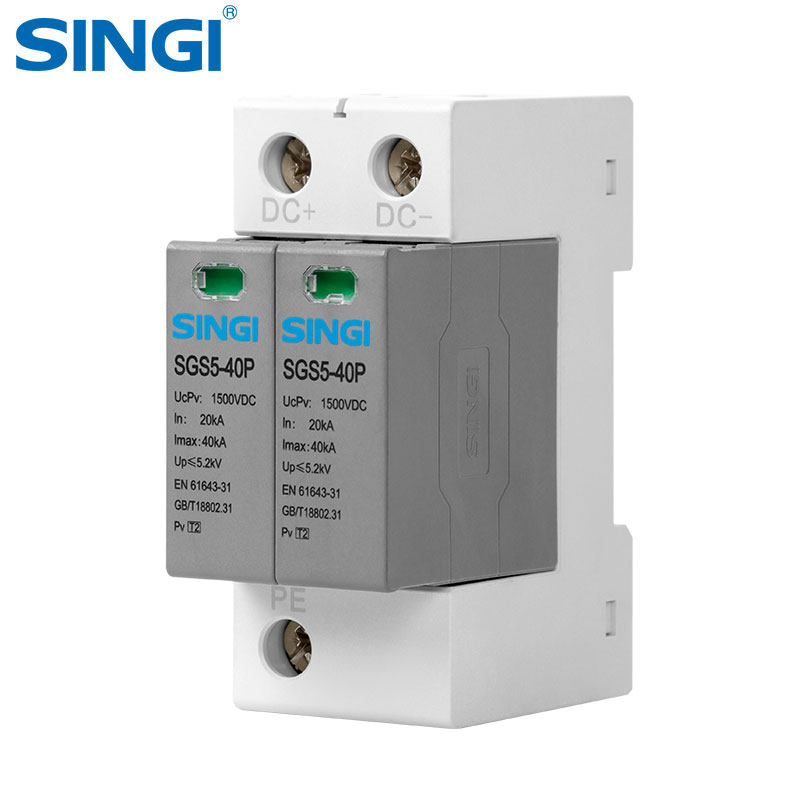
The SGS5-40P DC SPD Surge Protective Device from SINGI is a Type 2 surge protective device designed for photovoltaic DC power systems. It clamps transient overvolt-levels caused by lightning or switching operations, protecting PV modules, inverters, and monitoring equipment. This guide explains why DC-side surge protection is essential, how the SGS5-40P addresses common failure modes, and which parameters to assess when specifying an SPD. Explore the full PV Series on the SINGI website.
Photovoltaic arrays are installed outdoors, on rooftops or open fields, which exposes them to lightning activity and grid switching transients. The DC side of a solar system operates at high volt-levels — 500 V, 1000 V, or 1500 V — and any transient overvolt-level can stress insulation, damage semiconductors, and shorten the lifespan of inverters and other electronics. Unlike AC systems, DC arcs are harder to extinguish, so a surge that breaches the inverter input can cause catastrophic failure.
A dedicated DC surge protective device (SPD) is the first line of defense. The SGS5-40P DC SPD from SINGI is designed to detect overvolt-level spikes and divert them to ground, limiting the volt-level that reaches downstream equipment. Without such protection, repair costs and downtime can outweigh the initial investment. The international standard IEC 61643-11:2011 defines the performance and test requirements for low-volt-level SPDs, providing a benchmark for reliable DC protection in PV systems.
Transient overvolt-levels in PV arrays arise from several sources:
Each of these events can create volt-level spikes that exceed the withstand capability of PV modules, combiner boxes, and inverter input stages. The SGS5-40P addresses these risks by clamping the surge volt-level to a safe level and dissipating the energy without interrupting normal operation.
The SGS5-40P DC SPD Surge Protective Device is a Type 2 SPD built for PV applications. It is installed on the DC side, between the PV generator and the inverter. The device continuously monitors the volt-level across its terminals. When a transient exceeds the varistor threshold, it turns into a low-impedance path and conducts the surge amperage to ground. After the transient passes, it automatically returns to its high-impedance state, ready for the next event.
Key design features of the SGS5-40P include a nominal discharge amperage of 40 kA (In), a low volt-level protection level (Up), and a thermal disconnector that isolates the varistor in case of prolonged overload or end-of-life. The device also includes a visual status indicator, allowing maintenance teams to verify operation at a glance. Complying with both IEC 61643-11 and UL 1449, the SGS5-40P meets the requirements of major PV markets across Europe, North America, and Asia.
The table below compares the three common SPD types used in PV systems, helping buyers understand why a Type 2 device like the SGS5-40P fits most distributed-generation projects.
| SPD Type | Application | Test Waveform | Typical Location |
|---|---|---|---|
| Type 1 | Direct lightning strike handling | 10/350 µs | Main distribution board or combiner box at building entry |
| Type 2 | Switching and induced surge protection | 8/20 µs | Sub-distribution board, PV string combiner, inverter DC input |
| Type 3 | Equipment-level protection close to the load | Combination wave / 1.2/50 µs | Socket outlets or inside sensitive equipment |
Most PV strings experience switching and induced surges than direct lightning penetration, so a Type 2 SPD with 40 kA of nominal discharge amperage offers a solid balance between cost and protection. The SGS5-40P is rated for this duty.
Choice note: For installations in areas with high lightning density (keraunic level > 40), consider upstream Type 1 protection in addition to the Type 2 SGS5-40P to create a coordinated cascading SPD system.
When specifying a DC SPD for a PV system, engineers need to assess several parameters to ensure a proper match with the array configuration:
In PV systems, both the positive and negative conductors are exposed, so the SGS5-40P is configured as a 2-pole or 4-pole device depending on the array grounding scheme. The SINGI technical team can recommend the correct polarity configuration and remote signaling option for each project.
Correct installation is as important as the device itself. The SGS5-40P DC SPD should be placed as close as possible to the inverter or combiner box, with the shortest possible conductor length to the ground bus. Use cables rated for the expected surge amperage and keep the incoming and outgoing wires separated to avoid coupling. The SPD must be protected on the DC side by appropriate fuses or circuit breakers in accordance with IEC 62548:2016, which requires surge protection where the PV array is exposed to lightning.
Regular inspection should include checking the status indicator — green means the varistor is healthy; red or yellow signals end-of-life. The thermal disconnect feature will physically separate the varistor from the circuit, leaving the system electrically safe but unprotected. Replace the SPD immediately when the indicator changes. A proactive replacement strategy every 5–8 years, depending on surge frequency, keeps the PV system resilient.
Safety tip: Always disconnect the PV system before touching the SPD terminals. DC volt-level can be lethal, and the PV circuit remains live in sunlight even when the inverter is switched off.
AC and DC SPDs differ in their internal components, rated operating volt-levels, and energy handling characteristics. DC systems have continuous volt-level, so the SPD must handle a constant volt-level polarity and extinguish DC arcs that might form inside the device. The SGS5-40P is engineered for DC PV applications.
It should be mounted on the DC side, as close to the inverter or combiner box as possible, between the PV modules and the inverter. In string inverters, install the SPD on the DC input terminals. In central inverter plants, place it at every combiner box or at the main DC distribution board.
There is no fixed calendar interval. The SPD should be replaced when its status indicator signals failure, or after a documented surge event that exceeds the device’s nominal rating. Good practice is to check the indicator every three months as part of routine preventive maintenance.
Not alone. Type 2 SPDs like the SGS5-40P are intended for switching and induced surge currents. For direct strike risk, a Type 1 SPD with 10/350 µs waveform capacity should be installed upstream, at the service entrance or main distribution board.
Yes. The SGS5-40P is tested and certified according to IEC 61643-11:2011 and UL 1449, covering the safety and performance requirements for DC surge protective devices in low-volt-level photovoltaic installations.
Choosing the right DC SPD protects your investment and reduces downtime. The SGS5-40P DC SPD from SINGI offers proven Type 2 protection for PV systems, backed by international certifications and SINGI’s engineering support. Visit the SGS5-40P product page to download datasheets, view wiring diagrams, and contact the SINGI sales team for application-specific advice.
[1] IEC 61643-11:2011. Low-volt-level surge protective devices — Part 11: SPDs connected to low-volt-level power systems — Requirements and test methods. [S].
[2] UL 1449. Standard for Surge Protective Devices. [S]. 2021.
[3] IEC 62548:2016. Photovoltaic (PV) arrays — Design requirements. [S].