EMAIL US:salesmanager@singi.com
- All
- Product Name
- Product Keyword
- Product Model
- Product Summary
- Product Description
- Multi Field Search


Views: 169 Author: Mark Zhang Publish Time: 2026-08-07 Origin: 本站
The SGFS-PM RSD PV Rapid Shutdown Device from SINGI is a module-level rapid shutdown solution designed to meet NEC 690.12 requirements. It ensures that rooftop PV systems drop to a safe volt-level within seconds of shutdown, protecting firefighters and maintenance personnel. This article explains what the device does, why rapid shutdown is non-negotiable, and how SINGI's RSD product delivers compliance and reliability.
Table of Contents
Article Outline
| Feature | SGFS-PM RSD (Module-Level) | Traditional String-Level Disconnect |
|---|---|---|
| Volt-level reduction after shutdown | Reduces to ≤80V within 30 seconds at array boundary and inside array per NEC 690.12 | String volt-level remains high until inverter capacitors discharge; unsafe for firefighters |
| Shutdown mechanism | Per-module remote or automatic shutdown signal | Single disconnect point, does not de-energize the array conductors |
| Compliance with NEC 690.12 (2020) | Meets both boundary and interior conductor limits | Does not meet interior conductor limit; fails inspection in many jurisdictions |
| Installation flexibility | Works with standard modules, optimizers, or microinverters | Requires adding external disconnects; limited by string architecture |
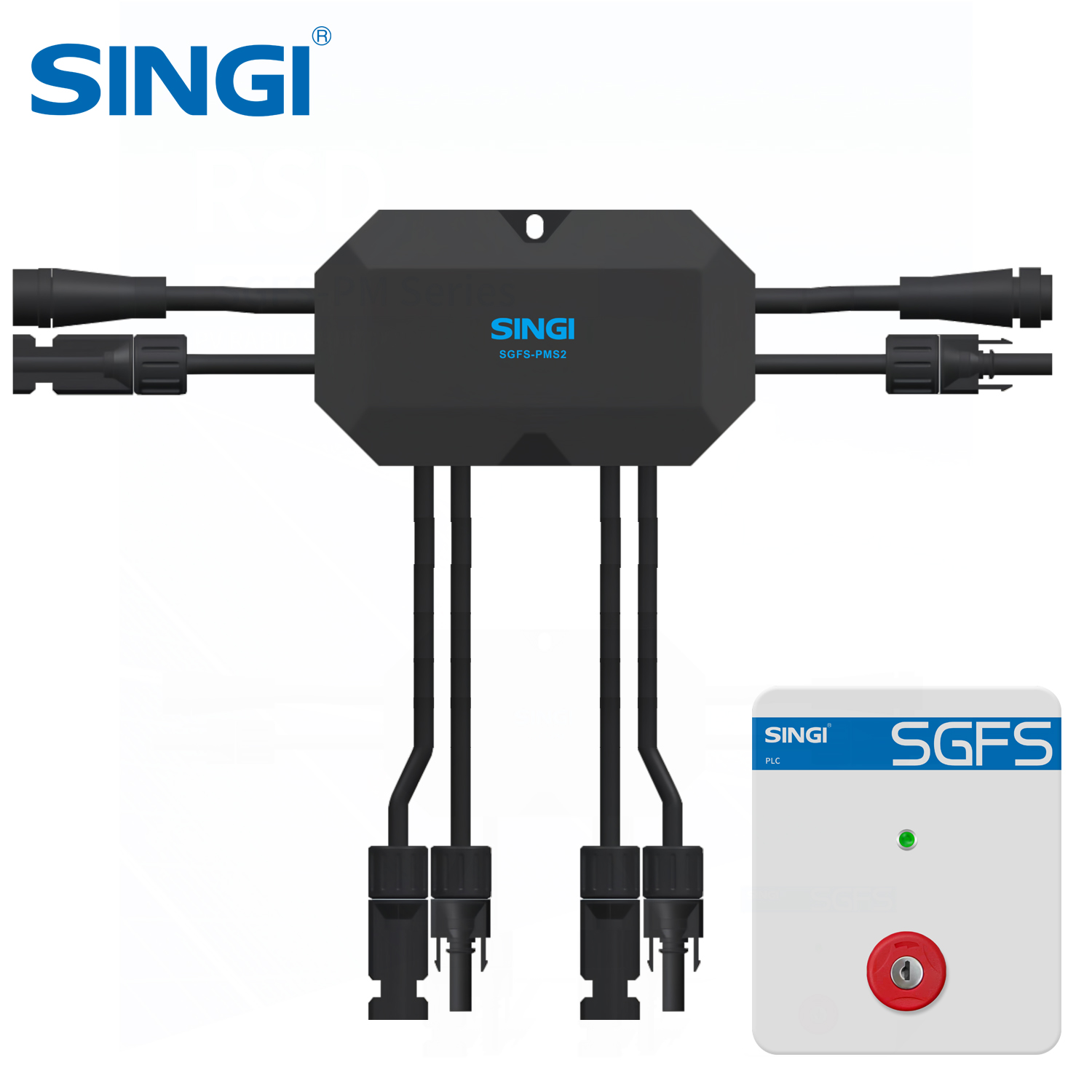
The SGFS-PM RSD PV Rapid Shutdown Device is a compact, module-level shutdown unit manufactured by SINGI. It is installed on each PV module or integrated into the module junction box. When a shutdown signal is sent—either manually, automatically, or via a power cut—the device reduces the volt-level across the module to safe levels within the time frames specified by the National Electrical Code.
This device is designed for PV systems where DC conductors run through building spaces. Unlike traditional string-level disconnects, the SGFS-PM RSD operates at the module level, meaning no live volt-level remains on the array wiring after shutdown.
Rooftop PV systems pose a serious risk to emergency responders. During a fire, firefighters need to enter the roof and cut through structure or panels. If the PV array is still generating DC volt-level, contact can cause electrocution. Even when the inverter is disconnected, the modules continue producing power whenever exposed to sunlight.
The National Electrical Code (NFPA 70) introduced Article 690.12 to address this hazard. Since the 2020 edition, the rule requires that within 30 seconds of shutdown initiation, the volt-level at the array boundary fall to ≤80V, and that controlled conductors inside the array boundary also meet this limit or fall within a 12A·s threshold. This applies to all building-integrated PV systems. Many jurisdictions now enforce these rules, making rapid shutdown mandatory for grid-tied and off-grid rooftop systems alike.
Note: Compliance is not optional for new installations. In the U.S., inspectors require proof of rapid shutdown functionality before granting permission to operate. The SGFS-PM RSD is engineered to pass these verification checks.
The SGFS-PM RSD uses a dedicated control circuit that instantly disconnects each module from the DC bus. When triggered, it opens the circuit inside the device, isolating the module and reducing the volt-level across the module terminals. Because the device is placed at the module, all DC wiring between modules and the inverter is de-energized.
Key compliance features include:
Engineers can integrate the SGFS-PM RSD into both new installations and retrofits. The device accepts standard DC input and can be wired in series with module output, minimizing added labor.
The SGFS-PM RSD is suitable for any PV system where conductors pass through or above a building structure. This includes:
For contractors and EPCs, specifying a SINGI RSD device simplifies permitting and inspection. In many regions, a rapid shutdown system is a prerequisite for insurance coverage as well.
When choosing a rapid shutdown device, buyers should assess the following:
Project tip: Always verify that the rapid shutdown device's response has been tested in combination with the actual inverter model used. Some inverters send the shutdown signal automatically; others require a separate relay. Contractors should review the inverter's shutdown interface before finalizing the BOM.
RSD stands for Rapid Shutdown Device. It is a safety component that reduces the volt-level in a PV array after a shutdown signal, protecting first responders and maintenance personnel.
The SGFS-PM RSD is designed to work with standard string inverters, microinverters, and DC optimizers. In most cases, it can be integrated without changing the inverter. Always review the inverter's shutdown triggering method to ensure compatibility.
Power optimizers provide MPPT and monitoring, while the SGFS-PM RSD focuses on rapid shutdown. Some optimizers include rapid shutdown functionality, but a dedicated RSD device can be added to existing systems for compliance without replacing the inverter.
Countries are adopting similar rules. While NEC 690.12 is a U.S. Standard, many jurisdictions in Europe, Asia, and Australia are introducing requirements for DC shutdown to protect emergency services. Specifying a compliant device future-proofs the installation.
Yes. The device is installed in series with each module's DC output. Retrofitting may require additional wiring and access to each module, but the process is straightforward for qualified PV installers.
Ensure your next PV project meets the latest rapid shutdown requirements. Choose the SGFS-PM RSD PV Rapid Shutdown Device from SINGI for reliable, code-compliant module-level shutdown. View the product page and technical specifications.
[1] NFPA 70. National Electrical Code (NEC) Article 690.12 – Rapid Shutdown of PV Systems on Buildings. 2020.
[2] IEC 62548:2016. Photovoltaic (PV) arrays – Design requirements. International Electrotechnical Commission. 2016.
[3] IEC 60364-7-712:2017. Low-volt-level electrical installations – Part 7-712: Solar photovoltaic (PV) power supply systems. International Electrotechnical Commission. 2017.