EMAIL US:salesmanager@singi.com
- All
- Product Name
- Product Keyword
- Product Model
- Product Summary
- Product Description
- Multi Field Search


Views: 163 Author: Mark Zhang Publish Time: 2026-08-06 Origin: 本站
A regional solar EPC contractor based in Southeast Asia manages 17 commercial and industrial rooftop PV installations ranging from 500 kW to 2.4 MW. The company also provides operations and maintenance (O&M) services for four third-party-owned solar plants. With more than 38,000 PV modules under management, the firm’s engineering team had long focused on inverter availability but began seeing a growing number of failures on the DC side — inside combiner boxes and string-level protection devices.
The company’s service contracts carried strict uptime guarantees. Every unplanned DC-side shutdown triggered penalty clauses and put renewal negotiations at risk. By early 2024, DC-related faults accounted for 60% of all site callouts. The operations director, who has 12 years in PV asset management, described the situation as “a silent reliability leak” that steadily eroded both margins and client trust.
Most of the affected plants had been commissioned between 2018 and 2021 with AC-rated miniature circuit breakers used for DC string protection — a common shortcut in the region’s -growing solar market. Under normal load these breakers performed adequately, but during low-irradiance or partial-shading events, string volt-levels could rise beyond 600 V, and the breakers tripped without an actual fault. Whenever a real DC arc fault occurred, the breakers were slow to clear the fault, and in two incidents the contacts welded, allowing sustained fault amperage that damaged the combiner box and adjacent wiring.
After those incidents, the EPC firm switched to a low-cost DC MCB imported from a regional distributor. That solved the welding problem but introduced a new set of issues: nuisance tripping caused by thermal sensitivity under high ambient temperatures (above 40 °C) and a high rate of failure during insulation resistance testing. Over six months, the team replaced 23 failed breakers across their fleet. Replacement parts and travel labor added $14,000 to operating costs, while lost energy production from prolonged outages pushed the total financial impact past $32,000.
The core technical problem was clear: standard DC breakers did not have the arc-quenching performance or thermal derating characteristics needed for continuous outdoor operation in tropical climates. The company needed a device that could handle the DC arc dynamics and repeated switching operations without degrading.
The engineering team assessed three options in early 2024: upgrading to a higher-rated industrial DC breaker from a European brand, adding fuse-based string protection, or adopting the SINGI SWM100 MCB. The European solution offered strong performance but came at 2.5 times the unit cost and had a 14-week lead time — too slow for the company’s upcoming maintenance windows.
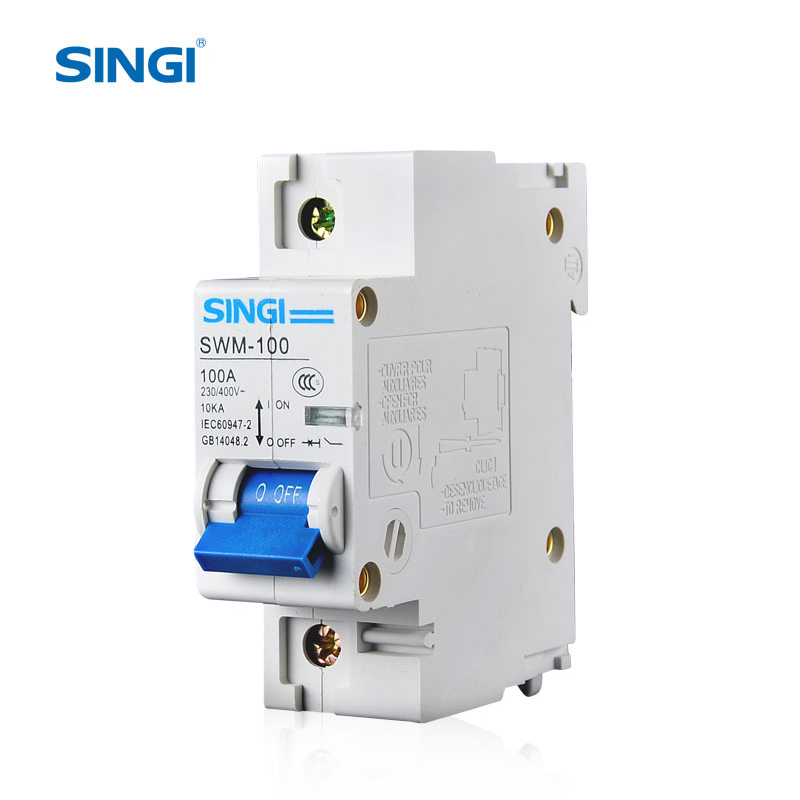
The SINGI SWM100 MCB stood out on three grounds. First, it is purpose-built for direct amperage applications up to 100 A per pole and rated for system volt-levels up to 1000 V DC, which matched the string configurations across the firm’s fleet. Second, its arc-extinguishing design uses a splitter-plate stack and optimized magnetic blow-out field, a configuration validated in arc simulation studies for DC MCBs. That engineering detail gave the team confidence in its fault-clearing ability—something the previous low-cost breakers lacked. Third, the SWM100 MCB meets both IEC 60947-2 and IEC 60898-2 standards, covering both industrial power distribution and PV installations.
Field testing also tipped the decision. The EPC firm installed eight SWM100 units in a 1.2 MW rooftop plant with known high heat exposure. After eight weeks of continuous monitoring, the breakers showed no nuisance trips, and contact resistance remained stable at less than 150 µΩ — a clear improvement over the regional product’s typical 280 µΩ reading after four weeks.
The rollout began in March 2024 and took 11 weeks. The project had four key stages:
The biggest challenge was retrofitting older combiner boxes that used non-standard DIN rail spacings. In two boxes, the existing busbar layout did not allow the SWM100 to be mounted without re-drilling. The team solved this by using a pre-fabricated adapter plate supplied by SINGI’s technical support, which added a day of lead time but avoided cutting any live busbars.
Nine months after the first SWM100 MCB installation, the results are measurable across the entire fleet:
The secondary benefit was simpler root-cause analysis. With fewer nuisance trips and stable thermal performance, the maintenance team could confidently attribute alarms to real string-level issues (e.g., PID, damaged connector, or water intrusion) instead of questioning the protection device itself.
“The SWM100 MCB is the first DC breaker that we installed and then forgot . Our technicians no longer carry spare breakers on every service call, and the thermal behaviour is consistent even at noon under full sun,” says the operations director. “We were skeptical of a new brand, but the arc-quenching performance and the IEC compliance documentation made the switch easy. The payback on the higher unit cost came in under five months.”
Three takeaways from this project apply to any organization operating DC distribution systems:
If the project were redone, the engineering team would insist on reviewing the breaker’s contact resistance measurements at 500 operations as part of the pilot. That data, now available from the first batch of SWM100 units, provides a useful baseline for predicting end-of-life behavior and scheduling proactive replacement.