EMAIL US:salesmanager@singi.com
- All
- Product Name
- Product Keyword
- Product Model
- Product Summary
- Product Description
- Multi Field Search


Views: 268 Author: Mark Zhang Publish Time: 2026-06-10 Origin: 本站
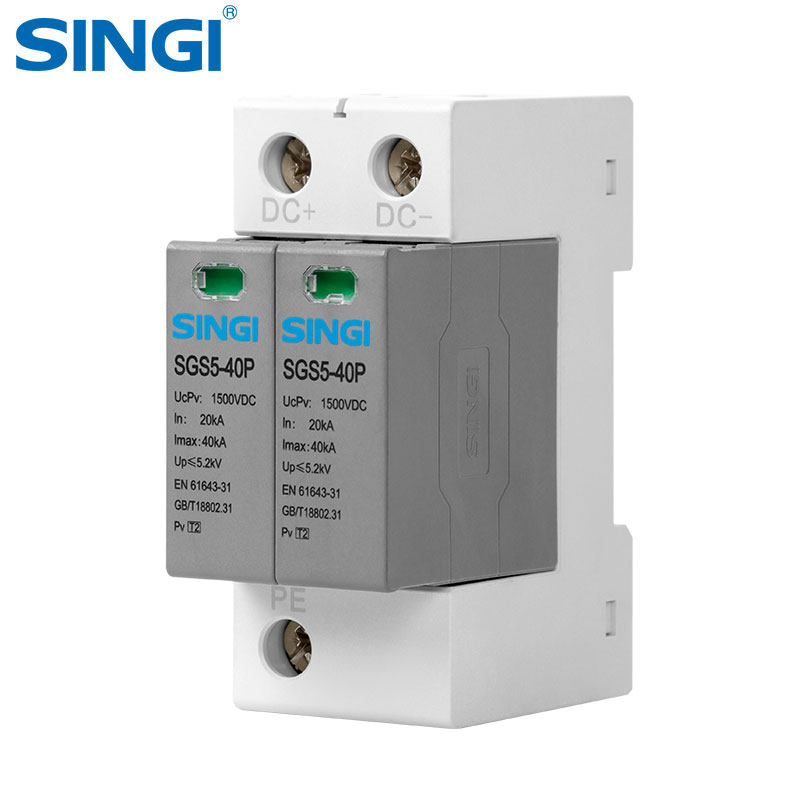
Chooseing a reliable DC surge protective device is critical for photovoltaic systems to prevent costly downtime and equipment damage. This guide explains key parameters, standards, and practical buying considerations for engineers and procurement professionals. For a detailed product overview, visit the SGS5-40P DC SPD page on singi.
This article provides a technical yet accessible overview of DC surge protection for PV systems. It covers common pain points, chooseion criteria, and product-specific insights to help B2B buyers make informed decisions. Throughout the text, we reference the SGS5-40P model from singi as a case example.
Photovoltaic arrays are often installed on rooftops or open fields, making them highly exposed to lightning strikes and switching transients. Unlike AC systems, DC circuits have no natural zero-crossing point, which makes arc extinguishing more challenging. A surge event can damage inverters, combiner boxes, and monitoring equipment. According to IEC 61643-11, a surge protective device must be properly rated for DC applications to handle these unique stresses.
Many installers underestimate the risk. Even indirect lightning can induce high voltages over long cable runs. Without adequate protection, repair costs and system downtime can quickly outweigh the investment in a quality SPD. This is where a robust DC surge protective device like the SGS5-40P from singi becomes essential.
AC-rated SPDs are not suitable for DC circuits due to differences in voltage polarity and arc behavior. A dedicated PV surge protection device is designed with proper DC voltage rating (Ucpv), higher surge current capability, and appropriate thermal disconnection. The SGS5-40P is a Type 2 SPD per IEC 61643-11, offering up to 40kA (Imax) surge current and a low voltage protection level (Up). This ensures that sensitive PV electronics remain safe even under severe transients.
Standards like UL 1449 also mandate specific testing for DC SPDs, including endurance and thermal stability. Choosing a product that complies with both international and regional standards reduces compliance risk for integrators and end-users.
Note: Always verify that the SPD's Ucpv is at least 1.2 times the system's open-circuit voltage (Voc) to avoid premature aging or failure.
Chooseion involves matching the SPD's electrical characteristics to your array configuration. Key steps:
For a typical 1500V system, the SGS5-40P comes in variants with higher Ucpv. Always refer to the datasheet and site-specific lightning risk assessment.
When assessing DC surge protective devices, focus on these specifications:
| Parameter | Importance | SGS5-40P Example |
|---|---|---|
| Ucpv (Max continuous DC voltage) | Must exceed system Voc | 1000V / 1500V |
| Imax (Maximum discharge current) | Higher = better surge handling | 40kA (8/20 μs) |
| Up (Voltage protection level) | Low Up protects downstream gear | ≤3.8kV at 20kA |
| In (Nominal discharge current) | Indicates endurance | 20kA |
| Protection mode | L+ / L- / PE | L+ & L- to PE |
| Standards compliance | IEC/UL certification | IEC 61643-11, UL 1449 |
The SGS5-40P from singi meets all these criteria, making it a reliable choice for commercial and utility-scale PV plants.
Q1. What is the difference between Type 1 and Type 2 DC SPDs?
Type 1 SPDs handle direct lightning strikes (10/350 μs waveform) while Type 2 (like the SGS5-40P) handles induced surges (8/20 μs). For most PV systems, Type 2 is sufficient unless the array is in a high lightning density zone.
Q2. Can I use one DC SPD for both positive and negative conductors?
Yes, many DC SPDs offer two-pole protection for L+ and L-. The SGS5-40P includes both poles in a single module.
Q3. How often should a DC SPD be replaced?
SPDs have a limited life. Most manufacturers recommend inspection every 2-3 years or after a major surge event. The SGS5-40P features a thermal disconnect and status indicator to simplify maintenance.
Q4. Are DC SPDs mandatory for PV systems?
Many national electrical codes (e.g., IEC 60364-7-712) require surge protection for PV systems. Check local regulations.
Q5. What makes singi's SGS5-40P stand out?
It offers high surge capacity, low Up, and compliance with IEC and UL standards, backed by singi's experience in DC protection.
For a reliable DC surge protective device that meets international standards, consider the SGS5-40P from singi. Visit the product page for full specifications and ordering details.
References:
[1] IEC 61643-11:2011. Low-voltage surge protective devices — Part 11: SPDs connected to low-voltage power systems. International Electrotechnical Commission, 2011.
[2] UL 1449. Standard for Surge Protective Devices. Underwriters Laboratories, 2021.
[3] IEC 62548:2016. Photovoltaic (PV) arrays — Design requirements. International Electrotechnical Commission, 2016.